 |
Compressed Air Trams
By John Prentice |
|
|
Compressed Air Trams
By John Prentice |
Following its success in Nantes and Paris, the Mékarski company turned its eyes to Switzerland. On 1st July 1889, in a consortium with others (including Vevey and Ludwig & Schopfer), Mékarski was granted a concession to build and operate a line in Bern, and the Berner Tramway Gesellschaft was formed.
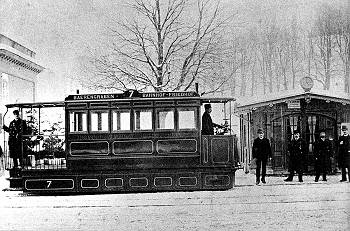 Bern Mékarski car 7 at the terminus at Bärengraben in 1895. The tram stop was opposite the depot and bear pit at the east end of the Nydeggbrücke.
A metre gauge line of single track with passing loops, with trackwork by Demerbe & Cie. of Belgium, was constructed, running the 3.1 km. from Bärengraben via Bahnhof to Bremgarten Friedhof (the bear pit to the cemetery). Cars were reversed at termini by turntable, an extra one being later added at Bahnhof, the central point. After testing, a public service commenced on 1st October 1890 with a ten minute headway. In the first full year of service 1,146,532 passengers were carried.
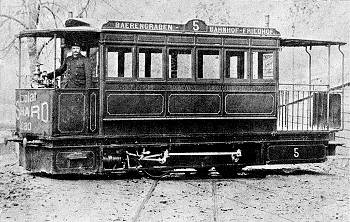 Bern Mékarski car 5 on the turntable at Bärengraben depot in the autumn of 1896. Note the panels open to reveal the mechanism.
The depot was at Bärengraben where there were three compressors, flywheel driven at 80-90 r.p.m. from water turbines, one normally kept in reserve. Cars could be charged on three tracks of the depot. Compressed air and steam (for re-heating water in the bouillotte) were supplied via two mains from the depot to a charge point at the terminus by Nydeggbrucke. In the early days there were problems with condensate freezing in these pipes in winter, later solved by lagging and re-routing.
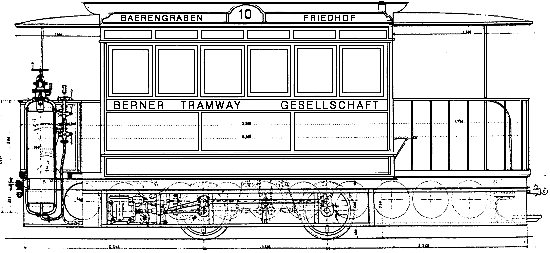
There were ten cars (numbered 1-10) which were very similar to the later cars at Nantes. They were built to Mékarski designs by Ludwig & Schopfer of Bern (now Von Roll AG), with bodywork by Blech & Winkeleisen. The trucks were two axle of 1.6 metre wheelbase, the front axle being driven by two cylinders of 130mm bore and 220mm stroke, the axles being joined by connecting rods. Walschaert's valve gear was used and all mechanism was enclosed by horizontal hinged panels. The bodies were single ended with a large rear platform and were 6.9 metres long and seated 28, weighing 9.5 ton laden. The cars had 700 mm diameter wheels, and travelled at about 12 kph with a maximum speed of 15 kph. These Bern Mékarski cars developed 10 horse power.
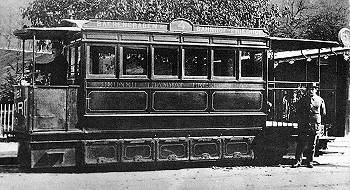
Bern Mékarski car 4 at Bärengraben |
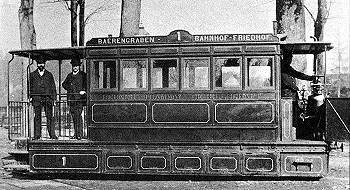
Bern Mékarski car 1 at Friedhof |
Eighty kilograms of air was stored in ten reservoir cylinders mounted transversely under the floor with a capacity of 2,100 litres, split 1,375 litres in a main set with 745 litres in reserve. These reservoir cylinders were charged at 30 atmospheres. Air passed to a standard Mékarski patent bouillotte mounted on the front platform. This was 350 mm diameter and 1.475 metres high. It was three quarters full of water at 165 degrees centigrade and on top was mounted the usual speed control wheel, which supplied air to the driving cylinders at 5-9 atmospheres. Four-block wheel brakes were applied by air from the traction supply being fed via a three-way valve, similar to the Paris cars described later.
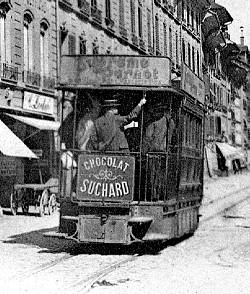 Rear view of a Bern Mékarski car in Spitalgasse, probably around 1900. Electric trams on other routes can still be seen at this location.
The cars ran successfully for eleven years, although other new routes all used steam traction and the air system was not extended. Electric traction won out and the route was electrified, the last air car running on 15th November 1901, trams themselves being replaced on this service by the trolleybuses that run today, partly in 1940 (Bahnhof to Bärengraben - now part of route 12) and partly in 1965 (Bahnhof to Friedhof - now part of route 11).
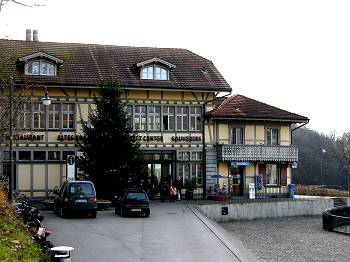 Bärengraben depot as it is today, the Altes Tramdepot Brauerei & Restaurant.
The compressed air car depot at Bärengraben still exists. It was at one time used as a garage and between 1971 and 1982 as a theatre storage facility. It was converted into a bar and restaurant in 1998. Their own beer is brewed on the premises.
Note: It has been suggested that two similar looking compressed air cars ran in Neuchâtel, but these were in fact gas engined. (see Lytham Gas Tram postcard for details).
 Go now to Next Section
 Return to Index